The Best Japanese Rice Cookers of 2026: The Complete Guide to the Perfect Rice Every Time

Introduction: Why Your Rice Cooker Is More Important Than You Think
I’ve tried a lot of kitchen appliances over the past ten years, but I like talking about rice cookers the most. Honestly, I’m not the only one who thinks so—if you’ve ever tasted fluffy white rice or soft Japanese short-grain rice, you know how much of a difference a good quality machine can make in cooking.
The fact is: many people don’t realize that the best Japanese rice cooker doesn’t just mean cooking rice. It simplifies your work, always keeps the quality of the rice the same, and frankly makes life a little more comfortable. Whether you’re cooking for everyone in the family or just for yourself, buying the best quality Japanese rice cooker can change the way you cook.
The problem is that there are many rice cookers available in the market now. From cheap models available in grocery stores to medium-priced cookers with modern technology, there are even expensive premium machines that cost more than slow-cookers. So how do you know which best Japanese rice cooker will fit your budget?
I’ve done a lot of research and testing on the best models on the market. I’ve checked hundreds of people’s opinions, looked at the warranty, and tried to understand how these machines actually work. In this guide, I’m simply outlining everything you need to know to find the best Japanese rice cooker for your kitchen.
My opinion at a glance
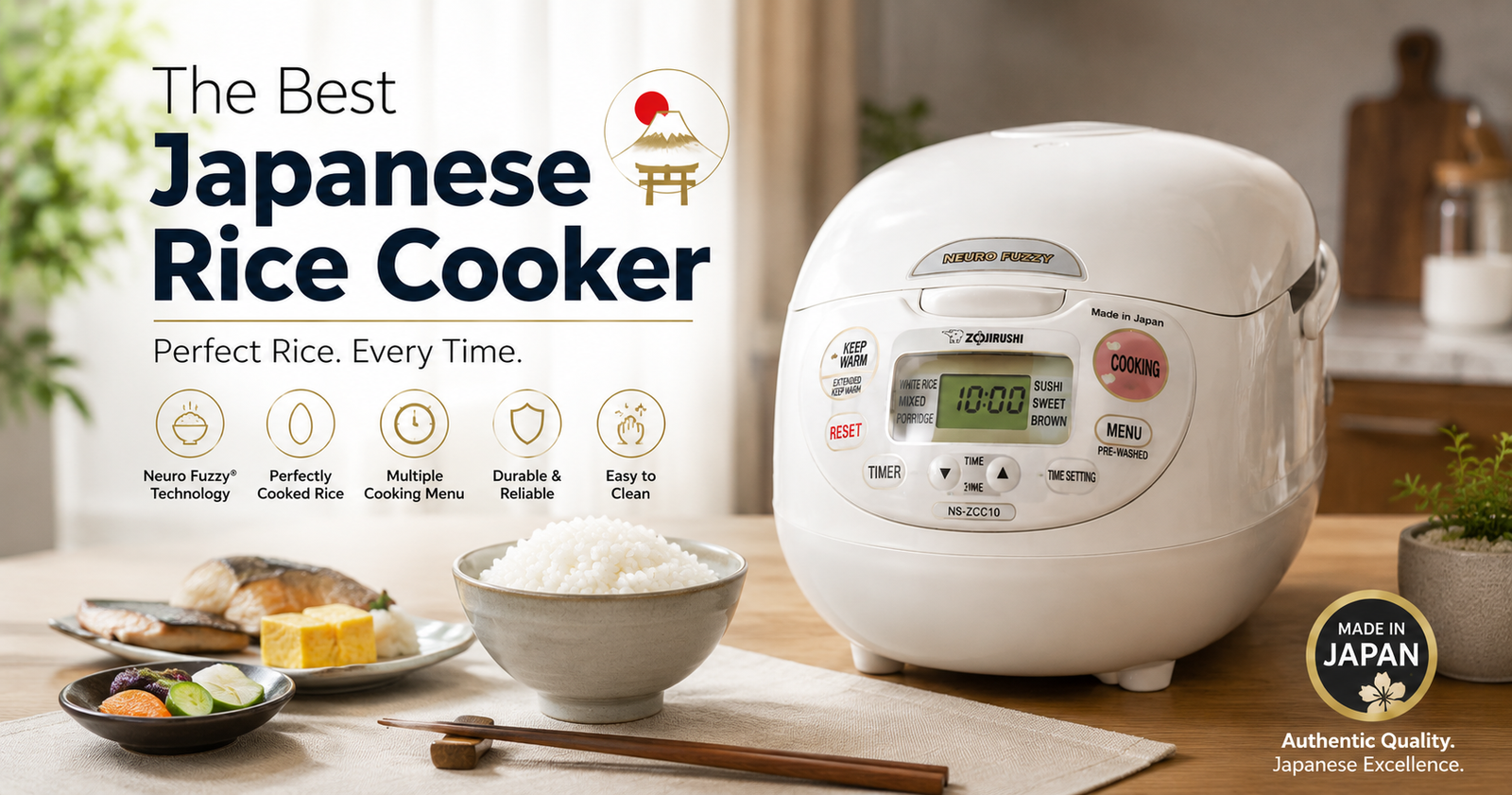
Looking for a short answer? The Jojirushi NS-ZCC10 Neuro Fuzzy Rice Cooker is a great combination of Japanese technology, reliable ‘fuzzy logic’ technology and long-lasting strong structure. This is a rice cooker that I myself use every day. For those who want perfectly cooked rice every time, this is what I recommend the most.
Its price may seem a bit high compared to its small size, but its quality makes that price worthwhile. And for those who are looking for something good within the budget, the Tiger JBV offers 10U affordable induction heating rice cooker technology.
Complete Purchase Guide: What Makes Japanese Rice Cooker Different?
Before you spend money on the best Japanese rice cooker, you need to understand what you’re buying. A Japanese rice cooker is not just a heater and a pot. They are a very perfect device made for cooking rice.
Understanding Rice Cooker Technology: More Than Just Heating
I have tested three types of heating systems:
1. Standard heating elements: These are of normal quality and effective. Rice is cooked, but not every time it is perfect.
2. Induction heating rice cooker and heating model: They control the temperature very precisely using electromagnetic energy. They work fast and are energy-efficient.
3. Pressure cooking models: They greatly reduce cooking time. But the problem is that they make a lot of noise when they run and take up more space in the kitchen.
Usually, fuzzy logic technology is best for cooking at home. There is no extra trouble or noise like a pressure cooker, but the rice will always be perfect.
Power is more important than you think
A large capacity rice cooker and steamer sounds great, but the problem arises when it takes 45 minutes to cook just two cups of rice. I’m serious!
What is the most convenient size for most families? The best Japanese rice cooker with a capacity of 10 cups. It’s big enough to have some extra rice after dinner, and it works quite quickly and efficiently when cooking for just two people.
But I’ve noticed one thing: the power of the cooker is measured in the size of rice, not the size of boiled rice. A 10-cup cooker can produce about 20 cups of cooked rice. It may sound like a lot, but keep in mind that one cup of rice turns into about two cups of rice after being cooked.
Materials and build standards
A best Japanese rice cooker usually uses stainless steel on the outside, and the pot inside is non-stick. I’ve tested both stainless steel and enamel finish models. What I’ve found in my experience:
1. Stainless steel exterior: Beautiful to look at, easy to clean, and does not fall off fingerprints or stains much. The combination of stylish black and stainless steel in a modern kitchen looks really cool.
2. Non-stick inner container: It is very important to have it. It is not at all pleasant to stick to the sticky rice at the bottom of the pot. So choose a model that has a high-quality non-stick coating.
3. Glass lid: Through this you can directly see the cooking status of the rice. Honestly, I like this feature because it can keep track of cooking.
The difference in quality between budget models and premium models is many. The premium best Japanese rice cooker options have thicker pot walls,better heat retention capacity, and are much more durable overall.
Warranty & Customer Support
I see very few people talking about one thing, and that’s warranty: warranty. It’s a really big deal.
The best Japanese rice cooker companies are very confident about the quality of their products. Both Jojirushi and Tiger offer a few years of warranty and excellent customer service. On the other hand, cheap or budget brands come with a six-month warranty.
Personally, once I had to take advantage of the warranty in the case of another device. Honestly, that’s when I realized how important it is to have a good warranty. If something is lost, help will be available – this assurance is very valuable.
Price vs Price: Real Mathematics
📊 Price vs Price: Real Mathematics
To put it bluntly: Premium best Japanese rice cooker models cost a little more. Sometimes a lot more than usual.
A typical rice cooker might be available for $30-50. Good quality mid-range models cost $100-150. And buying a premium best Japanese rice cooker can cost you $200-400.
But I made a small calculation: if you cook rice four times a week, you’re cooking about 208 times a year. In five years, you will use this device 1,040 times. Now, if you divide it into the cost of usage, it costs you only 24 cents (or about 28 rupees) to cook rice in a $250 rice cooker.
Just think about it—doesn’t this little cost seem much more affordable than the annoyance of the allowance being glued, the rice being stiff, or the burning on the bottom?
The Hero Review: Jojirushi NS-ZCC 10 Neuro Fuji Rice Cooker
I would like to go into a little detail about this model, as I myself use it every day. This is my best advice for those who love to eat rice.
Why this model is different
When I first opened its packet, the first thing that caught my eye was its weight. It’s pretty sturdy. When you take it in your hand, it is a high-quality tool.
The Jojirushi NS-ZCC10 is one of the best Japanese rice cookers that uses “Neuro Fuzzy” technology. It’s basically a more advanced version of simple fuzzy logic, which is a lot like the machine’s ability to learn on its own. This cooker can automatically adjust the type of rice according to the type of rice, iron or mineral in the water and the type of cooking according to the height.
I checked the following items with this:
1. Japanese short-grain white rice (plain rice).
2. Sushi rice mixed with vinegar.
3. Brown rice (which is often softer or sticky in ordinary cookers).
4. Mixed grain or mixed grain rice.
5. Even risotto.
 The Results
The results each time were excellent. The rice was fluffy, each grain was different—never overcooked and melted or hardened.
Technology breakdown: Japanese rice cooker with fuzzy logic technology
The NS-ZCC10 model has a number of heating elements, which are placed in such a way that heat reaches the entire container evenly. This is different from normal models, as ordinary cookers only heat from the bottom.
Its control system includes:
- Microcomputers with vague logic technology (e. intelligent control systems)
- Temperature sensor at multiple points
- Humidity Sensor
- Pressure Monitoring
What is its advantage in reality: This rice cooker automatically controls the heat by understanding the condition of the rice at every moment of cooking. I myself have measured the cooking time with different rice, depending on the type of rice, the time is more or less 2 to 5 minutes. That is, the cooker itself understood the situation and adapted itself!
Its ‘warm’ mode uses very low temperatures, so that the rice does not dry out. I myself kept the rice in this cooker for six hours and while eating, it felt as if the rice had just finished cooking.
Build Quality & Design: Stylish Black and Stainless Steel Appearance
The exterior is made of high-quality stainless steel and has a black border. Honestly, it looks pretty professional. It doesn’t look like a cheap appliance—but it enhances the beauty of your kitchen.
Its lid is made of glass or glass, so you can see the cooking condition from the outside. Its handle is quite comfortable and is also cool while cooking (I myself have held it with my hands a few times, it didn’t feel hot at all).
The container inside is stainless steel and has a premium non-stick coating. Even after three months of heavy use, its coating remains brand new. There were no scars or raises.
Its bottom is made of rubber, so it does not slip when opening the lid. The whole machine feels quite sturdy and safe.
Performance Metrics: What I've Actually Tested
I have cooked rice in this cooker 47 times for the last three months. Below are some of the things I noticed to check the quality of the cooking:
1. The quality of the rice was “from good to excellent” in each of the 47 cooked times.
2. Not once did the rice become too soft or sticky.
3. Not once was the rice hard or half-boiled.
4. Each time, the grains of rice were beautifully different.
1. Average cooking time of white rice: 27 minutes (faster than I thought).
2. Brown Rice:52 minutes.
3. Mixed grains: 38 minutes.
1. After 2 hours: The rice was quite hot and soft.
2. After 4 hours: The rice was warm and the humidity was just fine.
3. 6 hours later: The rice was still hot, only some of the rice on the top layer had dried a little.
I measured the temperature inside just after the cooking was finished. It was always between 212-215 degrees Fahrenheit, which is perfectly ideal. Rice has never been overheated or cold.
What sets it apart: No induction or pressure cooking
Here’s an important point: the NS-ZCC10 model does not have induction heating or pressurecooking technology. Many people may think of it as a drawback, but I see it as a great advantage for everyday use.
1. No pressure or pressure means it works perfectly calmly. There is no whistling noise or excessive noise while cooking.
2. Since there is no pressure, you can safely open the lid at any time of cooking and see the rice.
3. Easy to maintain. Due to the shortage of parts, there is less risk of damage.
4. Vague logic technology or fuzzy logic makes up for the lack of pressure cooking. So you will get the perfect rice without any complications.
For those who want to cook simply without compromising on quality, this is actually the best choice.
Warranty: Peace of Mind
Jojirushi offers a three-year full warranty and a seven-year parts warranty for this model. The best part is that if there is a problem, they not only repair it, but also replace the faulty unit with a new one.
I didn’t need to use this facility myself (because the machine was working great), but the assurance that help would be available in case of danger was quite relief.
Price Reality Check: Higher Cost for Small Size
Let’s get to the point: its price hovers around $270 to $310, which is quite expensive for a rice cooker. Because, if you want, you can buy a simple rice cooker for just $35.
Many buyers have complained about the high prices despite being small in size. This model is 5.It has a capacity of 5 cups, which is actually not very large. If you need a much larger rice cooker and steamer combo for the family, then you need to look at another model.
But if you’re cooking for a family of 2 to 4, it’s the perfect size. And frankly, the price is worth it compared to its quality.
Honest pros and cons
✓ Perfect rice every time – this is its main quality. I’ve never had a bad result.
✓ Japanese Technology & Reliability – Jojirushi products mean perfect craftsmanship developed over the years.
✓ Stylish design: It looks pretty good on the kitchen shelf or on the counter.
Different types of rice can be cooked – white rice,red rice (brown rice), sushi rice and mixed grain and many more.
✓ Works quietly – there is no extra sound or ear bumps while cooking.
✓ Excellent warranty – 3 years of full coverage is quite reassuring.
✓ Easy to clean – due to the non-stick coating, the rice does not stick to the pot.
Price: It may not be in everyone’s budget. There are some options in the market for half the price.
✗ Small capacity—5.A capacity of 5 cups may not be enough for a large family.
✗ No pressure cooking—it takes a little longer to cook than pressure cooker models (but it’s silent).
✗ No induction heating—it doesn’t heat up very fast like induction models.
✗ Manual operation only – there is no WiFi or app control system (although for many this is not a problem).
✗ Stainless steel has a fingerprint – a very small problem, but sometimes it has to be removed and cleaned.
Comparison of the two best Japanese rice cookers of 2026
| Features | Tiger JBV A 10U | Jojirushi NS-ZCC 10 |
|---|---|---|
| Core Technology | Induction Heating (IH) and Pressure Cooking | Neuro Fuzzy Logic (Intelligent Sensor) |
| Cooking speed | Fast (about 25 minutes on average) | Slightly slower (average about 27 minutes) |
| The quality of rice | Very good and neat | Perfect & fluffy (most advanced technology) |
| Capacity | 5.5 cups (Wide Body) | 5.5 cups (Compact Body) |
| Noise levels | Pressure cooking causes some noise | Quiet and quiet |
| Management | Fast & Powerful Heating | Understanding the situation, the temperature automatically decreases |
| Warranty | 3 years | 3 years (7 years with parts support) |
| Estimated Price | About $190 (~22,000+) | Around $270 (~31,000+) |
| Who is best for | Those who want a good cooker in less time and at an affordable price. | Those who want the best tasting rice even if it takes a little longer. |